“…Look, I’m absolutely sticking to this.”
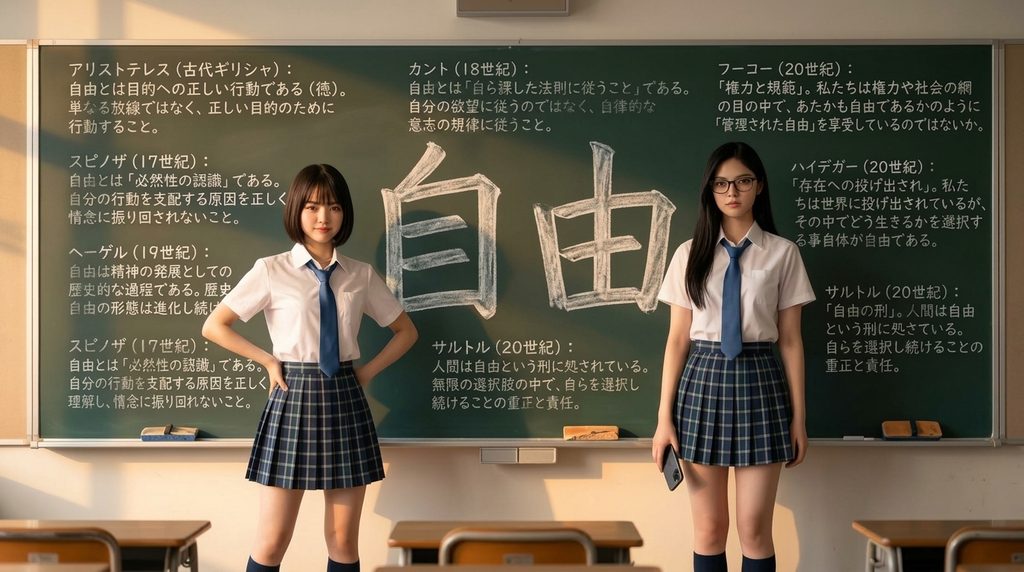
The science prep room was bathed in the dying orange glow of the afternoon sun. Dust motes danced in the air, and a well-worn blackboard stood before them, surrounded by scattered pieces of chalk. Okazaki turned to the board and wrote one massive word in the center: FREEDOM. A puff of white dust settled on her perfectly straight, bob-cut hair.
Next to her, Seto—a tall, pragmatic girl with long hair spilling over the desk—lifted her head with a dead-fish expression. She was Okazaki’s best friend, currently enduring the ultimate test of patience: listening to Okazaki struggle to find a topic for their “Independent Research” project on a rest day that Seto had specifically hoped to spend sleeping. Adjusting her thick-rimmed glasses, Seto spoke up.
“…Look, what? …I know we haven’t picked a topic yet,” Seto sighed.
“Exactly! To break through this ‘unfree’ situation where I can’t decide on a topic, I have decided to dissect ‘Freedom’ itself. I’m going for the ultimate meta-structure. I will conduct ‘Independent Research’ on the ‘Freedom’ of ‘Independent Research.’ This is the intellectual frontier of our school!”
Seto, who was tall enough that she had to look up at Okazaki, wore a ‘here we go again’ expression.
“…Right. The ‘intellectual frontier,’ I hear you. So, how exactly are you planning to do this? Read every philosophy book in existence?”
“No! I will trace the history of ‘Freedom’ and borrow the wisdom of the ancients to expose the ‘Traps of Freedom’ that we fall into today. Look at this list!”
Okazaki whipped out a notebook that was, strangely enough, elegantly designed.
“First, Ancient Greece. Aristotle spoke of ‘Freedom toward an End.’ Freedom isn’t just acting on impulse; it’s acting correctly toward your purpose (Virtue). In other words, freedom isn’t just the ‘freedom to eat sweets,’ but the ‘freedom to pursue the right purpose’ for eating sweets. Basically, calculating your calories before you eat them is an act of freedom.”
“… (That’s not freedom, that’s just being health-conscious.)” Seto muttered.
“Next, the Modern Era. Spinoza! He proposed ‘Freedom as the Recognition of Necessity.’ Freedom is understanding the causes that govern our actions. Look, Seto! The reason we mindlessly scroll through social media is because we’re being governed by algorithms. If we can meta-cognize that reason, that’s the first step toward true freedom.”
“… (…Stop with the heavy words. Just give me the conclusion.)”
“Not yet! Kant said freedom is ‘obeying the laws we give ourselves.’ Being enslaved by your own desires isn’t freedom; following the rules your own soul dictates is! And then there’s Hegel, who argued that freedom evolves as the development of the spirit through history. From slavery to democracy—the accumulation of history created the freedom we have today!”
Okazaki spoke with feverish intensity, her chalk screeching against the board.
“And finally, the modern age. Sartre spoke of ‘The Condemnation of Freedom.’ Man is condemned to be free. It’s agonizing because we have to choose everything for ourselves. …Hey, Seto, isn’t that exactly how I feel right now?”
Okazaki grabbed Seto’s shoulder with a tight grip.
“…No, I just want you to pick a homework topic already.”
“Wrong! That is mere ‘frustration at a lack of options’! I have chosen to make the theme of my project ‘Freedom.’ This decision itself is the proof of my freedom!”
Okazaki threw her hands up as if declaring victory.
“Conclusion! In the modern era, Freedom is ‘the ability to choose silence by cutting through the noise of excessive information and choices.’ The reason I couldn’t decide on a topic was that I was unconsciously exercising my ‘freedom to do nothing.’ …Got it? I’m presenting it exactly like this. And you, Seto, will serve as my ‘Realistic Straight-Man’ and record this historic moment!”
“…No way. Can I go home now?”
“No! We cannot be free until we complete this presentation, as we are bound by the spirit of our research!”
In the twilight of the classroom, Okazaki wore a triumphant (and slightly terrifying) smile. On the blackboard, amidst the clouds of chalk dust, stood an incredibly sophisticated, and utterly meaningless, dissection of “Freedom.”
[Appendix: Independent Research Presentation]
Theme: Results of Dissecting “Freedom” within Independent Research
Researchers: Okazaki (Lead: Dissection of Freedom) / Seto (Support: Maintenance of Reality)
[Motivation]
Based on the school’s principle that “No one can achieve anything alone,” we chose to study the core of “Independent Research”—Freedom itself. We define the stagnation of not being able to choose a topic as the “enjoyment of freedom to do nothing” and aim to meta-cognitively analyze its true nature.
[Philosophical Analysis]
- Aristotle (Ancient Greece): Freedom is action toward an end (Virtue). It is not license, but acting correctly toward a purpose.
- Spinoza (17th Century): Freedom is the “Recognition of Necessity.” It is understanding the causes that govern our actions and not being swayed by passions.
- Kant (18th Century): Freedom is “obeying the laws we give ourselves.” It is autonomy—following the rules of one’s own will rather than desires.
- Hegel (19th Century): Freedom is a historical process of the spirit. The accumulation of history evolves the forms of freedom.
- Sartre (20th Century): “The Condemnation of Freedom.” Man is condemned to be free; the pressure of infinite choice and responsibility is the flip side of liberty.
- Heidegger (20th Century): “Thrownness into being.” We are thrown into the world, but the act of choosing how to live within it is freedom.
- Foucault (20th Century): “Power and Norms.” We might be enjoying “managed freedom,” where we feel free only within the nets of power and social norms.
[Redefining Freedom in the Modern Era]
Modern freedom is the ability to find silence by retreating from the ocean of excessive information and choices (noise) and choosing to “do nothing” by one’s own will.
[Conclusion]
The reason I could not decide on a topic for my research was that I was unconsciously enjoying my “freedom to do nothing.” Through this research, I have successfully acquired the “freedom not to look for a research topic.”
I Couldn’t Decide on a Topic for My “Independent Research” Project, So I Decided to Dissect “Freedom” Itself 〜Redefining the Present with the Wisdom of Philosophers〜